Engineering Data Chaos: Why Growing Teams Struggle with Design Versions, Revisions & Collaboration
The hidden challenges slowing down engineering teams — and why better data management matters.
Every Engineering Team Starts the Same Way
Every engineering team starts with a simple folder structure — and at first, it works. A handful of engineers, a few active projects, and everyone knows where to find the latest files.
Then the business grows. New engineers join, product variants multiply, and manufacturing, procurement, and quality teams all demand accurate, traceable information.
The challenge is no longer creating great designs. It’s ensuring everyone is working with the right information.
When Engineering Data Grows, Complexity Grows Faster
As products become more sophisticated, engineering data grows rapidly. CAD models, drawings, specifications, Bills of Materials, simulation results, and supporting documents all become interconnected.
The number of files may increase steadily, but the complexity of managing the relationships between those files grows much faster.
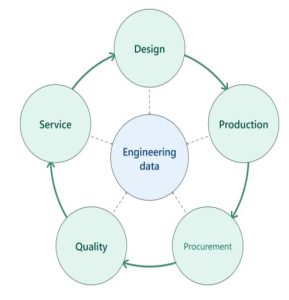
Engineering information doesn’t remain within the design department either. Manufacturing depends on released drawings. Procurement relies on accurate Bills of Materials. Quality teams require revision history and traceability. Project managers need visibility into approvals, while service teams often depend on historical design information years after a product has been delivered.
When engineering information isn’t managed through structured processes, every department feels the impact.
The Everyday Challenges Engineering Teams Face Many organizations experience these challenges as they grow:
-
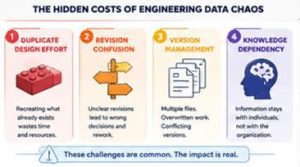
Finding the right design file: Engineers spend valuable time searching through folders, shared drives, and email attachments instead of focusing on design work.
-
Multiple versions everywhere: Files named Final, Final_New, Final_Updated, and Latest create uncertainty about which version is actually approved.
-
Revision confusion: Teams struggle to determine what changed, why it changed, who approved it, and whether manufacturing is using the correct revision.
-
Manual approvals and communication gaps: Design reviews, approvals, and engineering changes often rely on emails and manual follow-ups, slowing projects and increasing the likelihood of errors.
-
Knowledge locked with individuals: Critical engineering decisions remain with specific employees instead of becoming part of an organization’s engineering knowledge.
Individually, these issues may appear manageable.
Collectively, they slow product development, increase engineering effort, and introduce unnecessary business risk.
Why This Is More Than a File Management Problem
Engineering data is one of an organization’s most valuable assets.
Poor engineering data management doesn’t simply create untidy folders. It leads to delayed product releases, unnecessary engineering rework, manufacturing mistakes, procurement errors, reduced design reuse, and the gradual loss of valuable engineering knowledge.
These challenges rarely appear overnight. They develop gradually as organizations scale, often becoming visible only after they begin affecting customer deliveries, production schedules, or project timelines.
Imagine These Everyday Engineering Situations…
The Wrong Revision Reaches Production
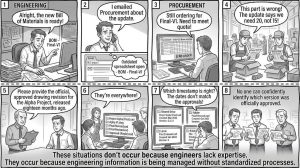
An engineer completes a design modification just before release. The updated drawing is emailed to manufacturing, but one production supervisor unknowingly prints yesterday’s version from a shared folder. Production begins using the obsolete drawing.
By the time the mistake is discovered, material has already been consumed, production schedules have slipped, and avoidable costs have been incurred.
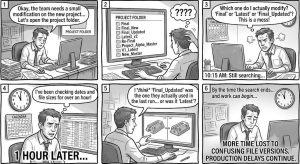
Searching for the “Latest” CAD Model
A design engineer receives a customer request for a small design modification. The project folder contains files named Final, Final_New, Final_Updated, and Latest.
Nearly an hour is spent determining which model should actually be modified before any engineering work can begin.
Knowledge Walks Out the Door
A customer requests a product modification nearly a year after delivery.
The original engineer has moved to another department, and no one can determine why a particular design decision was made or which revision was ultimately released.
Instead of building on previous work, the team spends days reconstructing engineering history.
Procurement Orders the Wrong Components
Engineering updates the Bill of Materials following a design revision.
However, procurement continues working from an outdated spreadsheet because the latest changes were never communicated.
Manufacturing discovers the discrepancy only after components have already been ordered.
The Audit No One Is Prepared For
During a customer or quality audit, the engineering team is asked to produce the approved drawing revision that was released eighteen months earlier.
Multiple copies exist across shared drives and local folders, each carrying different timestamps and filenames.
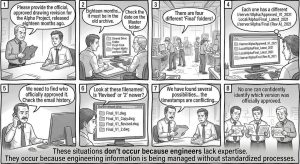
No one can confidently identify which version was officially approved.
These situations don’t occur because engineers lack expertise.
They occur because engineering information is being managed without standardized processes.
Bringing Control to Engineering Data
As organizations continue to grow, managing engineering information requires more than folders and shared drives.
It requires a structured approach that ensures every stakeholder has access to accurate, approved, and traceable product data.
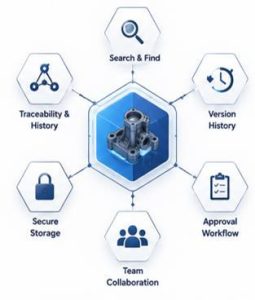
A Product Data Management (PDM) system provides that foundation by centralizing engineering information into a secure, controlled repository where every design change is tracked throughout its lifecycle.
Rather than relying on manual communication and disconnected file storage, engineering teams work within standardized workflows that ensure:
-
Only the latest approved designs are available for production.
-
Every version and revision is automatically recorded with complete traceability.
-
Engineering changes follow structured approval workflows.
-
Design, manufacturing, procurement, and quality teams collaborate using the same controlled information.
-
Existing designs can be located and reused instead of recreated.
-
Engineering intellectual property remains secure through controlled user permissions and complete audit trails.
For organizations operating under quality standards or regulatory requirements, maintaining revision history and complete design traceability is not simply a best practice. It is often a business requirement.
Building a Foundation for Sustainable Growth
As products become more complex and engineering teams become increasingly collaborative, the way organizations manage engineering data becomes just as important as the products they design.
Data Governance solutions help organizations establish structured engineering data management by centralizing CAD files and engineering documentation, automating revision and approval workflows, enforcing data governance, maintaining complete design history, and ensuring every stakeholder works with the correct information.
The objective isn’t simply to organize files.
It’s to create an engineering environment where information is reliable, traceable, secure, and readily available throughout the product lifecycle.
Organizations that establish these foundations early don’t just avoid costly mistakes. They enable faster collaboration, improve product quality, reduce engineering effort, and position themselves to scale confidently as their business continues to grow.
Because engineering teams don’t need more files.
They need more confidence in the information they’re using.










 Location