

ENGINEERING & PLM INSIGHTS
Manufacturers today must accelerate product development, improve engineering efficiency, and maintain quality while managing growing product complexity. Achieving this takes more than strong design tools; it takes a connected approach to product development and lifecycle management.
SOLIDWORKS Design enables organizations to connect engineering design with product lifecycle management, creating a more collaborative, structured, and traceable product development environment.
Product development involves a series of interconnected activities, including conceptualization, engineering design, validation, collaboration, change management, and product release. Managing these activities effectively is essential for maintaining consistency and ensuring that product information remains reliable throughout its lifecycle.
SOLIDWORKS Design provides an integrated design environment that enables engineers to create and modify 3D parts, assemblies, and engineering drawings while working with the 3DEXPERIENCE platform.
3DEXPERIENCE PLM extends these capabilities by supporting the management of product structures, revisions, engineering changes, lifecycle states, and release processes through the appropriate applications and workflows.
Together, these solutions help establish continuity between engineering design and the broader processes involved in developing and managing a product.
For example, when an engineering team develops a complex machine assembly, the associated product information can be managed within the connected platform environment. As the design evolves, teams can coordinate revisions, review engineering changes, and follow established approval and release processes. This connected approach helps organizations improve collaboration, maintain better control over product information, and establish a more consistent product development process.
Despite advancements in engineering technology, organizations continue to encounter challenges that can affect the efficiency and reliability of product development.
Addressing these challenges requires a connected environment that brings product design and lifecycle management processes together.
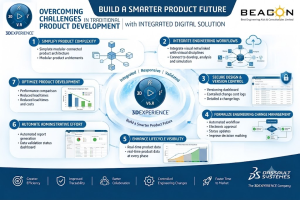
Understanding the fundamental concepts behind SOLIDWORKS Design and 3DEXPERIENCE PLM helps explain how they contribute to a connected product development strategy.
Together, these concepts establish a foundation for connecting engineering design with broader product development activities.
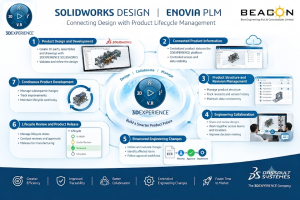
SOLIDWORKS Design and 3DEXPERIENCE PLM provide a connected approach to product development by linking engineering design with product information and lifecycle processes. The following workflow illustrates how organizations can use these capabilities.
Step 1: Product Design and Development. Engineers use SOLIDWORKS Design to create 3D parts, assemblies, and engineering drawings. Design modifications and engineering updates can be carried out as product requirements evolve.
Step 2: Connected Product Information. The associated design information is managed within the configured 3DEXPERIENCE environment. This enables authorized stakeholders to access relevant product information according to their permissions and the applicable lifecycle controls.
Step 3: Product Structure and Revision Management. Product structures and revisions are managed to maintain relationships between components, assemblies, and related engineering information. This helps teams understand the current product definition and distinguish between successive design versions.
Step 4: Engineering Collaboration. Design teams and other authorized stakeholders can collaborate using available platform capabilities. Relevant product information can be reviewed and shared to support engineering coordination and informed decision-making.
Step 5: Structured Engineering Changes. When a design modification becomes necessary, the organization can follow a defined engineering change process. The team evaluates the change, identifies affected product information, updates the design, and completes the required reviews and approvals.
Step 6: Lifecycle Review and Product Release. Product information progresses through the configured lifecycle workflow. The responsible stakeholders review the design and complete the required approval activities before the product information is released for its intended use.
Step 7: Continuous Product Development. Product development continues after the initial release. Subsequent modifications, revisions, and improvements can be managed through established lifecycle processes, helping maintain continuity as the product evolves.
By connecting these activities, organizations can establish a more structured approach to managing engineering information and coordinating product development. The specific capabilities available at each stage depend on the assigned roles, applications, permissions, and platform configuration.
Product development is evolving toward more connected, intelligent, and collaborative engineering environments. Several trends are expected to influence how organizations use SOLIDWORKS Design and 3DEXPERIENCE PLM.
These trends highlight the growing importance of connecting engineering design with product lifecycle management to support future manufacturing requirements.
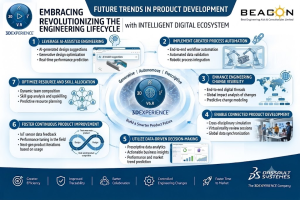
Product development is evolving toward more connected, intelligent, and collaborative engineering environments. Several trends are expected to influence how organizations use SOLIDWORKS Design and 3DEXPERIENCE PLM.
These trends highlight the growing importance of connecting engineering design with product lifecycle management to support future manufacturing requirements.
SOLIDWORKS Design provides the design environment for parts, assemblies, and engineering drawings, while 3DEXPERIENCE PLM connects product information with lifecycle management, collaboration, revision control, and release processes. Together, they help manufacturers improve engineering coordination, strengthen traceability, and manage product complexity with confidence.
The transformation from design to lifecycle is not simply about creating better 3D models. It is about connecting design, product information, people, and processes to support a more collaborative, controlled, and efficient product development journey
We Urge You To Call Us For Any Doubts & Clarifications That You May Have. We Are Eager to Talk To You
Call Us: +91 7406663589
Brigade Deccan Heights, 42, 14th Floor, 5th Mile, Tumkur Rd, Yeshwanthpur Industrial Area, Phase 1, Yeswanthpur, Bengaluru, Karnataka 560022
Rated 4.7/5 with a total of 62 reviews
#1120, 11th Floor, Solitaire business Hub - Baner, Balewadi High Street, Baner, Pune-411045
Rated 4.7/5 with a total of 17 reviews
801, 8th Floor, LODHA Supremus, I-Think Techno Campus,Kanjurmarg EAST - MUMBAI, MH, India – 400042.
Rated 5/5 with a total of 51 reviews
501, 5th Floor, Connekt Coworking Space, Gala Argos, Netaji Rd, Ellisbridge, Ahmedabad, Gujarat 380006
Rated 4.1/5 with a total of 7 reviews
Best Engineering Aids & Consultancies Ltd. No 306, Karunaa Conclave, 3rd Floor, AD Block, Shanthi Colony, Anna Nagar, Chennai - 600040
Rated 4.6/5 with a total of 16 reviews
A-101, 1st Floor, The Hub Complex, opp. Shete Hospital, Mahatma Nagar, Parijat Nagar, Nashik, Maharashtra 422005.
Best Engineering Aids & Consultancies Ltd (BEACON) Wellwork Workspaces, L1 - 1017A,B, Lower Ground Floor,Vasavi MPM Grand, Ameerpet, Hyderabad, Telangana 500073
2nd floor, Mokha Tower, Plot No.169, Mankapur Ring Rd, Trimurti Nagar, Nagpur, Maharashtra 440022


 Location